IGRS Telangana Market Value 2026: Check Circle Rates
You’ve found a flat in Kondapur. The seller says ₹85 lakh. Before you pay a token, you need to know what the government thinks that flat is worth — because that number decides your stamp duty, your loan ceiling, and whether the Income Tax Department raises an eyebrow later. That number sits on the IGRS Telangana portal, and pulling it takes about three minutes.
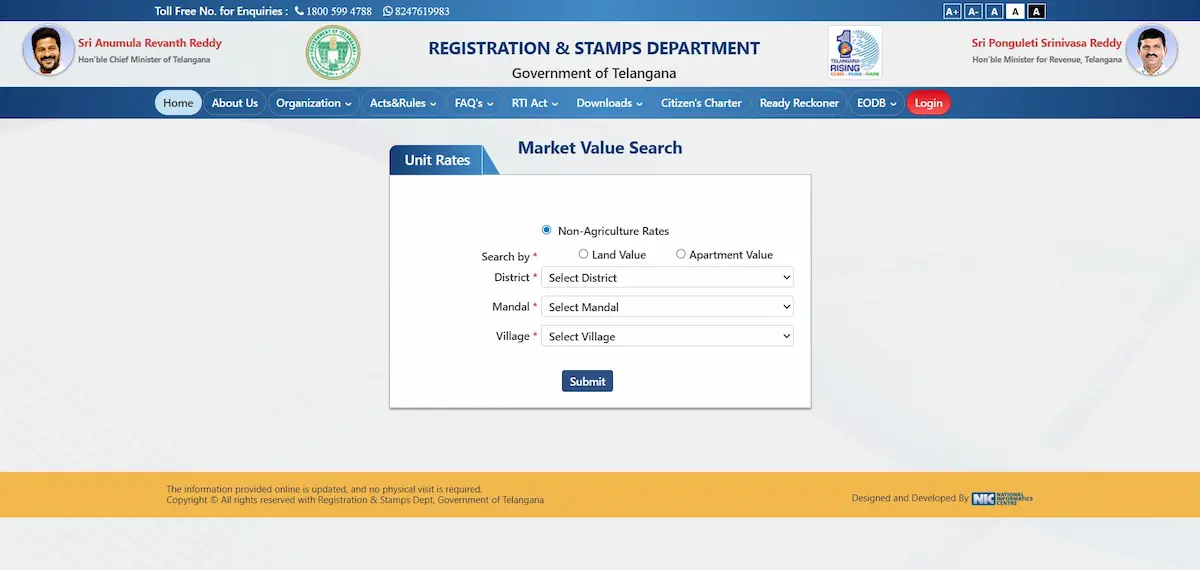
To check IGRS Telangana market value, open registration.telangana.gov.in/UnitRateMV/getDistrictList.htm, pick Land Value or Apartment Value, then select your District, Mandal, and Village. The portal shows the unit rate per square yard for plots or per square foot for flats. This is the circle rate — the legal floor, not the ceiling.
What IGRS Telangana Market Value Actually Is
Call it circle rate, guideline value, unit rate, or guidance value. Same thing. It’s the minimum price the Registration and Stamps Department will accept for a property in a given locality, set under the Indian Stamp Act, 1899.
Stamp duty in Telangana is charged on whichever is higher — the market value on the portal or the actual sale consideration. That’s the rule most first-time buyers miss. If the circle rate says your flat is worth ₹70 lakh but you’re paying ₹85 lakh, duty is on ₹85 lakh. Buy below the circle rate, and the SRO still charges duty on the circle rate plus you inherit an income tax problem under Section 56(2)(x).
The April 2025 Revision — Still the Live Rate in 2026
The Telangana government revised market values on April 1, 2025 — the first full recalibration in nearly a decade. In 2026, these remain the operative rates. No fresh revision has been notified.
IT corridor pockets moved the most. Gachibowli, Kokapet, Tellapur, Narsingi, and parts of the Financial District saw jumps between 30% and 50%. Outer mandals and rural gram panchayats moved less — often 15% to 20%. If you’re buying in a revised zone, your stamp duty bill looks nothing like what a friend paid two years ago. Check the portal first, not a WhatsApp forward.
Method 1 — Checking Land Value (Plots & Independent Houses)
- Open the Market Value Search page
- Choose Land Value
- Pick your District (Hyderabad, Rangareddy, and Medchal-Malkajgiri are separate — don’t mix them up)
- Select the Mandal
- Select the Village
- Pick the Ward Block or Locality from the next dropdown
- Click Submit

The result shows the per-square-yard rate for that locality. Write it down with the date of your check — rates can be revised, and you want a dated reference for your file.
Method 2 — Checking Apartment Value (Flats & Gated Communities)
Apartments work differently. The portal pulls a project-wise rate, not just a locality rate.
- Open the same portal page
- Choose Apartment Value
- Select District, Mandal, Village
- Pick your Apartment / Project Name from the dropdown
- Submit
The rate comes out as per square foot on super built-up area. If your project isn’t in the list — common for under-construction or very recent launches — the portal falls back on the village-level composite rate. That fallback is usually lower than what a built-up project would carry, which matters if a bank is valuing the flat.
When Your Locality or Project Isn’t Listed
Three things to try before panicking:
- Search the nearest listed locality within the same ward — the SRO generally accepts it as a proxy
- Check if the project is listed under the builder’s registered name instead of the marketing name (happens with rebranded launches)
- Visit the jurisdictional SRO with your sale agreement and ask for a spot valuation — they’ll issue a written rate within a day or two
Don’t guess. A wrong rate at registration triggers a Section 47-A reference, and that means months of back-and-forth with the Collector’s office.
Reading the Result — Don’t Skip This Part
The portal gives you a number. Turn it into the right number for your property.
- Plots: rate × extent in square yards = market value
- Flats: rate × super built-up area in square feet = market value
- Independent house: land rate × plot area + construction rate × built-up area
Watch the units. The portal sometimes shows per square metre instead of per square yard — 1 square yard = 0.836 square metres. A unit slip makes your stamp duty calculation wrong by 20% in either direction.
Stamp Duty & Registration Fees in Telangana (2026)
For a standard sale deed in a GHMC or municipality area:
| Fee | Rate |
|---|---|
| Stamp Duty | 4.0% |
| Transfer Duty | 1.5% |
| Registration Fee | 0.5% |
| Total | 6.0% |
Gift deed to a family member: 1% stamp duty. Partition deed among family: 0.5%. Mortgage with possession: 2%. Lease over 30 years: treated like a sale.
Worked example. Flat in Kokapet, circle rate ₹6,000/sq ft, super built-up 1,400 sq ft, sale price ₹95 lakh. Circle rate value = ₹84 lakh. Duty applies on the higher — ₹95 lakh. Total payable = ₹5.7 lakh.
For your own transaction, run the numbers through the official IGRS Duty Fee Calculator before you buy e-Stamps. The calculator handles the edge cases — women-buyer concessions in some deed types, agricultural-to-residential conversion impact, and rural registration fee variations up to 2%.
Why the Market Value Also Decides Your Loan
Banks run two valuations on a home loan file. The technical valuation (what their empanelled valuer says) and the legal valuation (what IGRS says). They sanction on the lower number, not the higher. If you’re paying ₹95 lakh for a flat the circle rate prices at ₹70 lakh, your 80% LTV is calculated on ₹70 lakh — not ₹95 lakh. That’s a gap of ₹20 lakh you’ll fund from your own pocket. Check the circle rate before you sign the sale agreement, not after.
What Happens If You Register Below Market Value
The Sub-Registrar has powers under Section 47-A of the Indian Stamp Act to refer an under-valued document to the District Collector. If the Collector agrees the consideration is below market value, you pay:
- The differential stamp duty
- A penalty — often equal to the shortfall, sometimes higher
- Interest on the unpaid amount
During the reference, the document is impounded. No bank disbursement. No mutation. No resale. Files have sat in Collector offices for six months or longer. It’s a bad trade for saving a few thousand rupees on duty.
Registering at or above the circle rate keeps you out of this queue.
A Quick Check Before You Hit Register
Before you pay e-stamps and book a slot, verify two more things alongside the market value:
- The seller’s sale deed is real — pull the deed details with the document number and year
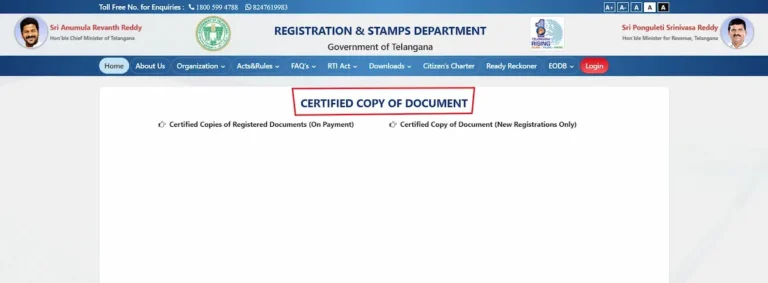
- The certified copy of the prior deed matches what the seller gave you — order a CC copy from the portal
These three checks — market value, deed verification, and certified copy — together cost under ₹1,000 and take under an hour. Skipping them costs lakhs.
Frequently Asked Questions
How often is IGRS Telangana market value revised?
There’s no fixed schedule. Revisions happen when the government notifies one. The last major revision took effect April 1, 2025, and those rates remain current through 2026.
Can I register a property below the IGRS market value?
You can try, but the SRO will charge duty on the circle rate regardless, and the Income Tax Department treats the gap as deemed income in the buyer’s hands under Section 56(2)(x). It’s not illegal, just expensive.
Is market value the same as the actual selling price?
No. Market value is the government’s minimum benchmark. Actual selling price is what buyer and seller agree to. They’re rarely identical — actual prices usually sit higher.
Do I need to log in to check market value?
No. Market value search is public and doesn’t require an IGRS account. Login is only needed for Public Data Entry, slot booking, and payments.