How to Find Pre-1983 Property Records in Telangana
In the modern real estate landscape of Hyderabad and the surrounding districts, “clear title” is the only currency that matters. However, a significant percentage of land in Telangana carries a messy history that predates the computerization of the Registration and Stamps Department.
If you are hunting for a Sale Deed, Gift Deed, or Partition Deed from the 1960s or 70s, you’ve likely hit a wall: the IGRS Telangana online search has a “hard floor” at 1983. In the industry, we call this the “digitization gap.” If your link in the title chain falls before ’83, the website won’t help you.
To bridge this gap, you have to go manual. This means navigating the historical jurisdictional shifts of the SROs (Sub-Registrar Offices)—where an old record might now sit in a completely different district office than where it was originally signed. You’ll need to file specific Certified Copy (CC) applications and physically track down the massive, handwritten “Book 1” archives to verify the flow of ownership.
The “No Records Found” Paradox: Understanding the 1983 Cutoff
The most common query we receive is: “Why can’t I find my 1975 sale deed on the IGRS website?”
The answer lies in the CARD (Computer-aided Administration of Registration Department) system. While Telangana has been a leader in digital governance, the structural migration of physical ledgers into a searchable digital database primarily covers records from January 1, 1983, onwards. Records prior to this date exist in massive, leather-bound volumes stored in the “Record Rooms” of the respective Sub-Registrar Offices (SRO). These are not indexed by name or survey number in the online cloud. They are indexed by document number, Year, and volume/pasti.
Why This Matters for Your Title
In Telangana, a “30-year search” is the minimum requirement for a bank loan or a legal opinion. As of 2026, a 30-year search takes you back to 1996—well within the digital era. However, to establish link documents (the chain of ownership), you often need to go back 40 or 50 years. If you cannot produce these pre-1983 links, your property value can drop, or worse, your sale can be stalled by legal objections.
The Manual Search Protocol
When the digital portal fails, you must follow the Manual Archive Protocol. This is a physical process that requires accuracy in paperwork.
Step A: Identify the Parent SRO
Due to the reorganization of districts in Telangana (moving from 10 to 33 districts), the SRO that currently governs your land might not be the one where the 1970s deed was registered.
- Example: A property in Medchal registered in 1978 might have its physical records in the Rangareddy District Registrar’s office or the original undivided Hyderabad archives.
- Action: Check the “Parent Office” list on the IGRS website or consult a local document writer to find where the “old volumes” for your specific mandal are currently housed.
Step B: Filing Form 22 (The Application for Search)
To trigger a manual search, you must submit Form 22. This is the formal “Application for Search or Issue of Certificate.”
- Provide Boundaries: Unlike digital searches, manual indexes often rely on the Schedule of Property. You must provide the North, South, East, and West boundaries exactly as they would have appeared in the original document.
- Specific Period: You must state the exact years you want searched (e.g., 1970 to 1982).
- The Search Fee: You will be required to pay a “Search Fee” via a Government Challan. This fee is for the labor involved in a clerk manually retrieving and turning the pages of the archival books.
Step C: Obtaining the “Manual EC”
If the search is successful, the SRO will issue a manual encumbrance certificate. This is a handwritten or typed document, signed and sealed by the sub-registrar. In the eyes of a High Court advocate or a Tier-1 bank, a Manual EC is often considered more “bulletproof” than a digital printout because it involves a physical verification of the ledger.
Essential Pre-1983 Revenue Records
Often, a sale deed isn’t enough. In Telangana, “Registration” proves a transaction occurred, but “Revenue Records” prove possession and land nature. For pre-1983 cases, these three documents are non-negotiable:
I. Khasra Pahani (1954-1955)
This is the “Mother Document” of land records in Telangana. Created after the Hyderabad Tenancy and Agricultural Lands Act, it lists the owner, the possessor, the survey number, and the land type (Wet/Dry/Inam). If your name or your ancestor’s name is in the 1954-55 Khasra, your title is exceptionally strong.
II. Sethwar
The Sethwar is the original survey record issued by the Survey and Settlement Department. It acts as the “Birth Certificate” of the land, detailing the original measurement and boundaries before any sub-divisions occurred.
III. Muntakhab
If the land was originally Inam Land (land granted by the Nizam or the Government for services rendered), the Muntakhab is the official decree that validates the grant. Without this, pre-1983 Inam land titles are often flagged under Section 22-A (Prohibited Properties).
Troubleshooting: What if the Record is “Torn” or “Missing”?
It is a harsh reality that some physical volumes from the 1950s and 60s have deteriorated or gone missing. If the SRO gives you a “Non-Availability Certificate,” you have two high-level alternatives:
- The State Archives at Tarnaka: The Telangana State Archives and Research Institute in Tarnaka, Hyderabad, houses microfilmed copies of many Nizam-era and early independence-era records. If the SRO copy is destroyed, the microfilm copy at the Archives is legally admissible.
- The Dharani “Missing Survey No” Module: For agricultural lands, if the old Pahanis are missing from the digital Dharani portal, you can file a formal grievance. You will need to upload any “Link Documents” you possess to prove the historical existence of that survey number.
Also Read: No OC, No Registration: New Telangana Building Law
Legal Insights: The “Section 22-A” Trap
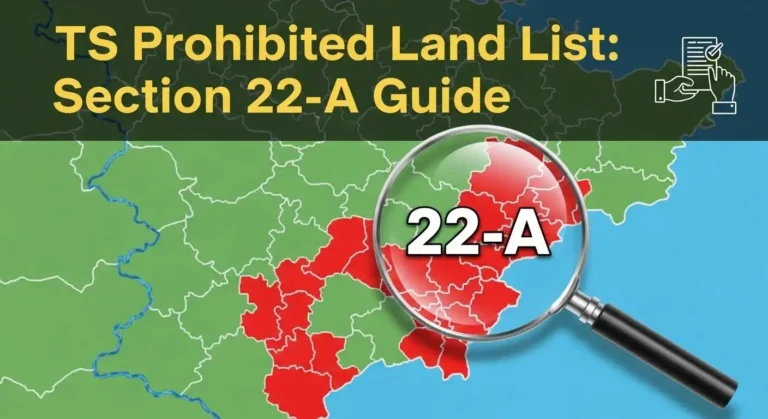
Why is everyone suddenly searching for pre-1983 records? Because of the Prohibited Properties List (Section 22-A). Many properties that were traded freely for decades are now being flagged as “Government Land” or “Waqf Land” because the digital records don’t show the original private ownership from the 1960s.
Frequently Asked Questions
Can I get a pre-1983 Encumbrance Certificate (EC) online?
No. The IGRS Telangana portal generally only provides digital ECs from 1983 onwards. For any period prior to this, you must apply in person at the jurisdictional sub-registrar office using Form 22.
How long does a manual search take at the SRO?
A manual search typically takes 7 to 15 working days. It requires a clerk to locate the specific volume in the record room and manually transcribe the entries.
What is a “Certified Copy” (CC), and why do I need it?
A certified copy is an official, SRO-stamped duplicate of the original sale deed. If you have the document number and year from your manual search, you should always apply for a CC. It serves as primary evidence in court if the original is lost.
My land is in a “Prohibited List,” but I have a 1970 deed. What should I do?
You must submit your pre-1983 deed along with the 1954-55 Khasra Pahani to the District Collector via the Dharani portal or a formal representation. This proves the land was “Patta” (private) before the government claims began.
Do I need a lawyer for a manual search?
While not legally required, it is highly recommended to use a licensed document writer or a lawyer. They understand the “Pasti” (volume) system and can navigate the archives much faster than a layperson.
Final Thoughts for Telangana Property Owners
The transition to a fully digital Telangana is nearly complete, but the “Ghost of 1983” still haunts many titles. By securing your pre-1983 records, you aren’t just filing paperwork; you are “future-proofing” your most valuable asset against administrative errors and legal challenges.